



The varieties of knee pain they bring us range from arthritic to injured cartilage, as well as the wear and tear that comes with age. Surgical treatments may be appropriate if non-invasive remedies (such as physical therapy, medicine and injections) are no longer effective. For patients considering Total Knee Replacement in Ahmedabad, deciding between a partial or full knee replacement is an important decision. Awareness of these variances can help patients make informed decisions in consultation with their orthopaedic surgeon.
Knee replacement, or arthroplasty, is a surgical technique that replaces damaged elements of the knee joint with artificial components. The goal is to alleviate pain, improve function, and increase quality of life. Your surgeon may recommend one of two surgeries depending on the extent of joint injury.
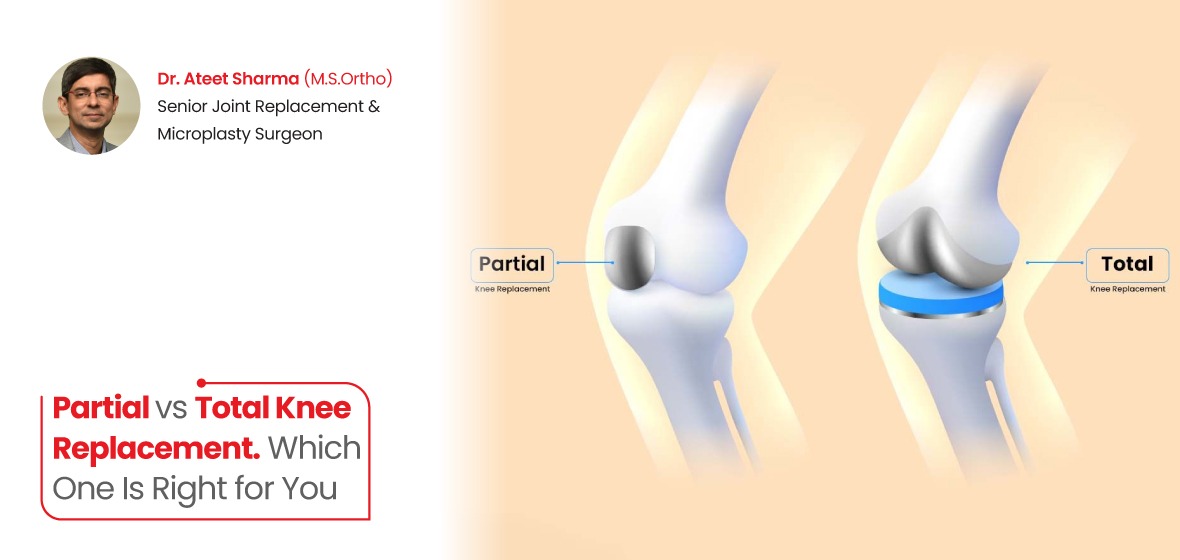
Partial knee replacement and unicompartmental Knee Replacement. You may be offered a Partial knee replacement, also known as Unicompartmental Knee replacement, in which only the damaged portion of the knee is replaced. The knee is divided into three compartments: medial (the inside part), lateral (the outside part) and patellofemoral (the front). Partial replacement may be an option if you have arthritis or damage in just one part of the joint.
In the operation, the surgeon cut away damaged cartilage and bone in the affected compartment of the knee and replaced it with a high-tech implant made from metal and plastic. The healthy cartilage, bone and ligaments in the remainder of the knee are left alone.
Partial knee replacement is typically indicated for patients who:
TKR (Total Knee Replacement) refers to the replacement of all three knee joint compartments. It is recommended for patients with significant knee arthritis or damage that affects multiple compartments of the joint.
The procedure is performed when other types of treatment have not obtained results, with the surgeon removing affected cartilage and bone from the thigh bone, shin bone and kneecap. These surfaces are then substituted with artificial prosthetic components, which recreate the joint's position and motion.
The following patients may be considered for a total knee replacement:
It is a minimally invasive approach, replacing only the damaged part of a joint as opposed to total knee arthroplasty, which treats the entire joint. This discrepancy can contribute to recovery duration and post-surgery knee function.
Recovery is generally quicker, and the return of knee motion is earlier in partial knee replacement patients. Total knee replacement and rehabilitation time takes longer, as it is a larger surgical area.
Some patients claim that having more of these knee structures makes a partial replacement seem more natural. Total knee arthroplasty relieves pain; it feels different from a normal joint due to resurfacing.
These are both good, solid implants, but long-term results rely on activity level, weight and overall joint health. Occasionally, this leads to a partial replacement having to be converted into a full knee replacement.
When comparing partial vs total knee replacement, the decision should be based on clinical assessment rather than preference. Imaging tests, such as X-rays or MRI scans, can be used to determine the severity of joint damage that has occurred. Age, activity, bone stock, and general health are also taken into consideration.
What do Orthopaedic surgeons who offer Total Knee Replacement in Ahmedabad look at?
As with all surgical procedures, partial or full knee replacement can have complications, including infection, blood clots, stiffness and problems with the implant. It is not appropriate to perform a partial knee replacement if the arthritis progresses into other compartments. In a total knee replacement, the surgery is more extensive than the recovery time. A discussion with a trained orthopaedic surgeon provides further insights into the pros and cons for each patient.
Replacement is done to decrease pain and improve daily function. Many patients recover excellent mobility and comfort after either of these procedures, after an appropriate indication. Compliance with post-operative physiotherapy and lifestyle advice is essential for long-term outcomes.
No one answer is best for everyone. Partial knee replacement can be effective for some with isolated damage, but total knee replacement is for severe or widespread osteoarthritis. It should only be based on medical examination, imaging and realistic expectations. Consult Dr Ateet Sharma for better assistance.
© 2026 Dr.Ateet Sharma All rights reserved. | Manage by Nexus