




You’ve just been told you need a hip replacement. Now it’s midnight, and you’re deep in search of ‘robotic vs traditional’, trying to figure out which one is actually right for you, and ending up more confused than when you started.
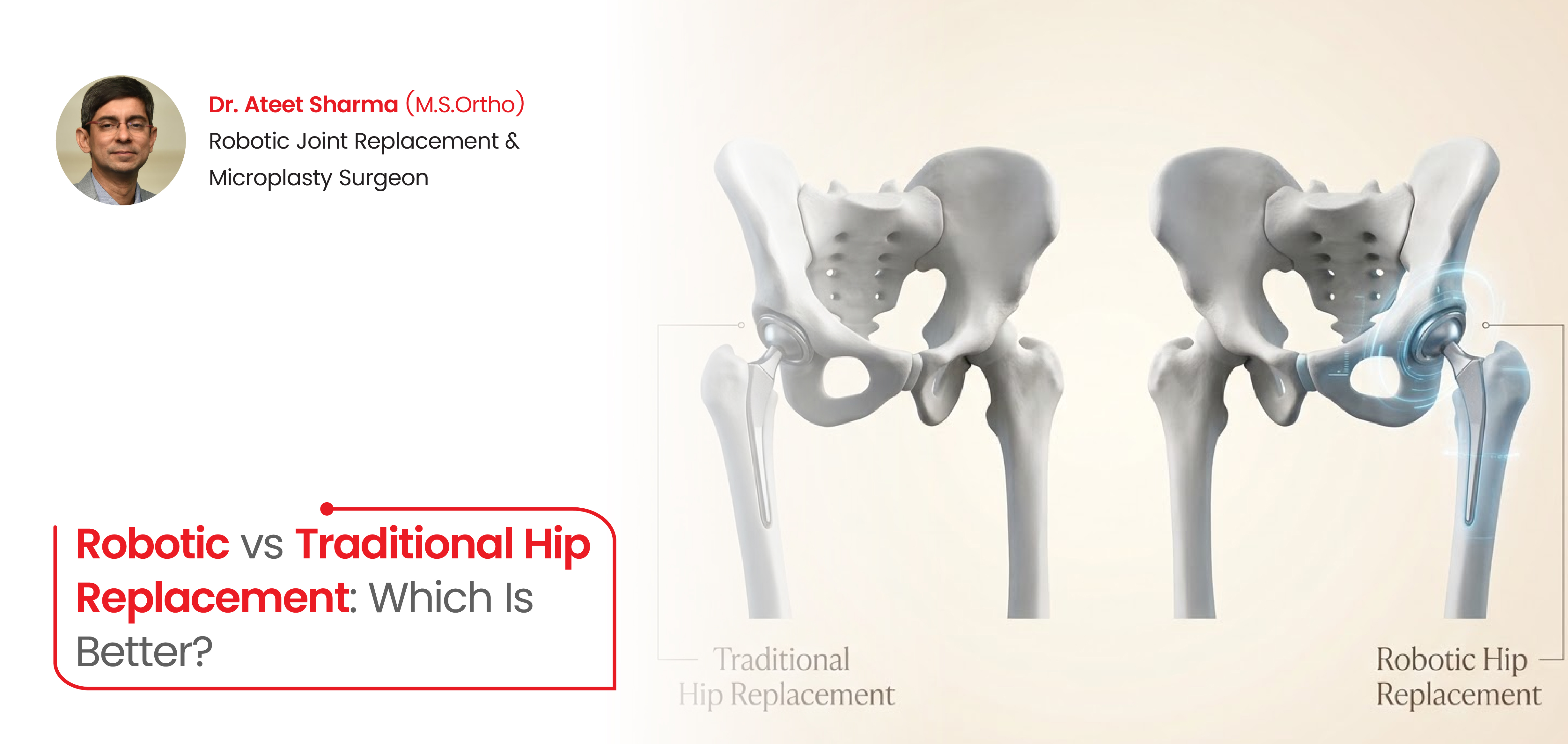
For most patients today, robotic-assisted hip replacement offers real, measurable advantages over the traditional approach, better precision, fewer complications, and more bone preserved. It’s worth understanding why more surgeons are moving toward it.
Dr Ateet Sharma, Robotic Surgery Specialist in Ahmedabad, helps patients determine which approach fits their case, weighing factors such as age, activity level, and joint complexity rather than defaulting to whichever technology sounds more advanced.
Here's how the two methods compare, what the research actually says, and how to think through the decision.
This is the more advanced, pre-planned approach to hip replacement, and it’s transforming how surgeons approach joint precision.
Before surgery even begins, a detailed 3D model of your hip is built from imaging, mapping out the exact size, angle, and position the implant needs to sit at, planned to your anatomy specifically, not a general estimate. In the operating room, this plan guides the surgeon’s every moment within those pre-set boundaries.
The traditional approach has been used successfully for decades, and it remains a safe, reliable option, particularly when performed by an experienced surgeon.
That said, it comes with natural limitations; there is no real-time guidance during surgery, so how well the implant sits depends entirely on the surgeon’s manual skill and judgement at the moment. Even in expert hands, that introduces more case-to-case variation than a guided, pre-planned approach allows.
The research shows a fairly consistent pattern :
| Robotic-Assisted | Traditional | |
|---|---|---|
| Planning | 3D CT scan mapped beforehand | Mostly 2D X-rays |
| Precision | Very high, guided by robotic arm | Depends on surgeon's hand and eye |
| Incision | Usually smaller | Slightly larger, though can be minimally invasive |
| Surgery Time | A bit longer (extra setup) | Usually quicker |
| Cost | Higher | Lower, more commonly covered |
| Availability | Only at hospitals with the system | Everywhere |
| Recovery | Possibly faster, evidence still mixed | Well established timelines |
| Track Record | Newer, less long-term data | Decades of outcomes data |
| Good For | Complex or revision cases | Straightforward cases, experienced surgeons |
The precision advantage of robotic surgery is genuinely well established. It’s also worth noting that some patients report their early recovery feels smoother with robotic surgery, likely linked to the reduced tissue disruption during the procedure.
Recovery time is generally similar with both robotic and traditional. A few patients who have robotic surgery notice that their early recovery feels a touch easier, possibly because the procedure disturbs less of the surrounding tissue.
Both routes lead to good outcomes for most people, and neither should be seen as automatically inferior. They're just different tools, each better suited to certain situations.
It comes down to a handful of things: your age, how active you are, how complex your hip condition is, and what your surgeon recommends based on your case.
Robotic precision might matter more, since your implant has more years of hard use ahead of it, so getting the fit right counts for more over that longer timeline.
Some conditions, like bone quality or prior surgeries, may make one method more suitable than the other. Your surgeon can assess this during your evaluation.
Both procedures can come with various costs in some cases. None of this makes one option universally better; it simply means the right choice varies from patient to patient.
A proper consultation is really the only way to know which approach makes sense for you.
Now that you understand how robotic and traditional hip replacements are different from each other. If you are feeling like this is relatable, then it’s time to visit an expert who can guide you based on your specific condition.
Dr Ateet Sharma specialises in both traditional and robotic-assisted hip replacement, and can help you figure out which one genuinely suits you. If hip pain is getting in the way of daily life, it's worth booking a consultation and talking it through properly. To book a consultation, call 9824061766 today.
Robotic-assisted surgery generally means more precise implant placement, fewer complications, and less blood loss. Both approaches offer strong long-term relief, but that added precision is why more patients are leaning on robotic surgery.
Yes. It's a safe and well-established technique. Robotic surgery has lower complication rates than the traditional approach.
A little, yes. The pre-surgical planning and guided precision add some time in the OR, but most patients feel it's a fair trade-off for the accuracy you gain.
Most patients are good candidates, though younger, more active patients often benefit the most, since precise implant placement matters even more over a longer lifetime of use.
Not at every hospital, robotic systems require specific equipment and surgeon training. Dr. Ateet Sharma offers robotic-assisted hip replacement for patients looking for this more advanced option.
© 2026 Dr.Ateet Sharma All rights reserved. | Manage by Nexus